Collective frenzy and ritualized violence
Lord of the FliesCollective frenzy and ritualized violence in Lord of the Flies emerge through repeated acts that make fear feel manageable by giving it a shared target and a collective form. Face paint first releases the hunter from ordinary self-consciousness; later, chants and dances bind the boys into a group whose shared excitement can overwhelm individual judgment and end in Simon’s death.
The Mask and the Hunter’s Transformation
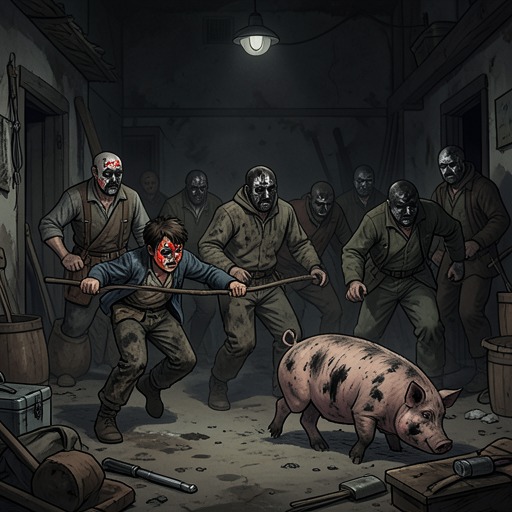
Jack Merridew’s face paint makes the change from individual boy to hunting persona visible. By a pool, he assembles white clay, red clay, and charcoal, explaining the paint as camouflage for hunting. His first attempt displeases him, and he washes it away; he then marks one cheek and eye socket white, the other half red, and draws a charcoal line across his face from ear to jaw. The water’s reflection is disturbed by his breathing, but when he sees the painted stranger looking back, he laughs, spills the water, and leaps up.
The mask becomes more than concealment. Jack Merridew dances, and his laughter turns to a bloodthirsty snarl; as he capers toward Bill, the painted face seems to act independently, while Jack hides behind it, freed from shame and self-consciousness. The sight unsettles Roger, who smiles, and Bill, who falls silent and blunders away. When Jack Merridew summons the twins and says he will creep up and stab, the mask has already helped carry the hunting impulse from his own body into the group. This early transformation establishes a pattern: ritualized appearance and movement do not merely disguise the boys but help make collective violence possible.
The Hunt Becomes a Collective Rite
The hunt for the sow turns pursuit into a group ordeal organized around blood, excitement, and imitation. After the animal breaks through the hunters’ line, they follow her through tangled forest, tracking drops of blood and the marks left by spears. When she collapses in a hot clearing, Jack Merridew stabs down with his knife while Roger presses his spear into her with his full weight. The killing gathers the boys around a single struggle; the sow’s terrified squealing, their exertion, and the spouting blood make violence a shared physical event rather than one hunter’s isolated act.
Once the sow is dead, the intensity does not immediately subside. Jack Merridew displays his bloody hands, and the others laugh as he smears the blood across Maurice’s cheeks. Roger’s spear, still lodged in the animal, prompts a crude joke that Robert and Maurice turn into a comic performance, reenacting the pig’s attempt to evade the thrust. The laughter converts the violence into a repeatable scene: the hunters can play at the killing even as they have just carried it out. Jack then guts the sow while the others watch, making the group’s attention gather around his handling of the carcass and his decisions about what follows.
The practical problem of making a fire becomes a reason to plan a raid on Ralph’s camp, while Jack Merridew reserves part of the kill for the beast. At his direction, Roger sharpens a stick at both ends; Jack drives one point into a crack in the rock and forces the sow’s head down over the other, leaving it impaled and dripping blood. He names it as a gift. The hunters draw back, fall silent, and then run together toward the beach, while Simon remains concealed among the leaves. The offering gives their fear a visible recipient and turns the aftermath of the hunt into a ritual: the severed head stands apart from the meat, and the group’s shared act of killing is followed by an act meant to appease the danger they imagine.
The Dance, Simon’s Death, and the Hunt for Ralph
The later dance turns the earlier hunting rite into a collective response to fear. As a storm gathers, Jack Merridew calls the boys to dance in the open space by the fire. Roger plays the pig, while the hunters take spears, the cooks take spits, and others carry firewood as clubs; the youngest boys circle the action. Ralph and Piggy, who had resisted the pull of Jack Merridew’s feast, find themselves eager to join the ring, whose brown backs seem to hem in the terror of the storm and make it governable. The chant grows from excited noise into a steady rhythm, and the boys move like a single organism. Repetition offers the feeling of safety, but it also makes the crowd’s violence increasingly difficult to interrupt.
When Simon stumbles from the forest trying to tell the boys about the dead parachutist, they do not recognize him. The chant continues as the circle turns toward the figure entering it, and the boys call him the beast. Simon is knocked down; the crowd strikes, bites, and tears at him until he breaks through the ring and falls to the sand. The storm and rain continue over the group, while the body lies apart from them on the beach. The scene makes the rite’s double action unmistakable: the dance briefly binds the boys together against a feared threat, but its shared excitement turns an attempt to bring the truth back to the group into a killing.
Afterward, Ralph identifies what happened as murder, while Piggy insists that darkness, fear, and confusion made it an accident. Piggy also asks Ralph not to tell Sam and Eric that they were part of the dance, trying to draw a boundary between their participation and the group’s violence. Ralph rejects the comfort of that distinction: he remembers that they were present, even if they stood outside the circle for part of the night. The disagreement shows how the ritual’s collective force persists after the chant stops: it has left Ralph with a burden of recognition, while Piggy reaches for denial as a means of living with what they did.
The refrain and the circle return later as signs of the tribe’s continuing order. From near Castle Rock, Ralph hears the boys dancing and eating; Sam and Eric now guard the rock against him. During the final pursuit, the hunters’ cries spread through the forest as they search for Ralph, who hides beneath a thicket with a stake sharpened at both ends. When a hunter peers into the darkness and discovers him, Ralph bursts out, swings the stake, and runs as the others close in. A fire races through the forest alongside the chase, driving him toward the beach, where he falls before a naval officer and the hunters’ cries falter. What began as a dance meant to contain fear has become a hunt for a human target; collective ritual now serves pursuit, and the island’s burning accompanies the violence that finally brings the boys into view of the outside world.
From Assembly to Crowd
The conditions for collective frenzy appear within the boys’ first attempt to establish order. Jack Merridew arrives leading the choir in two disciplined lines, their black cloaks and silver badges making the group look like an organized institution. At the election, however, the boys choose Ralph, partly because the conch and the authority of the platform have set him apart. Jack retains the choir and names them hunters: the same group is thus placed within a shared structure but also given a separate identity and purpose. The later rituals do not arise from a crowd without organization; they grow out of a community whose roles and loyalties have already begun to divide.
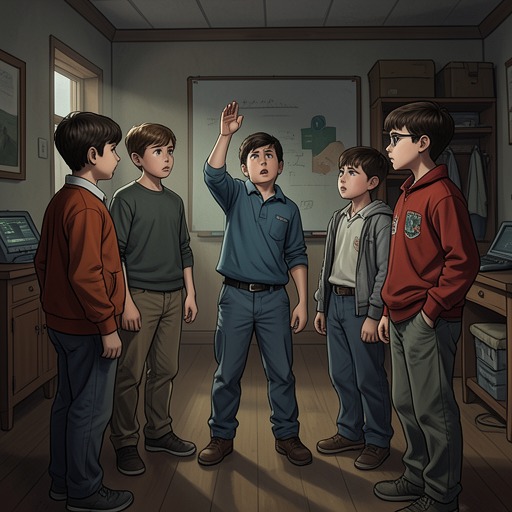
At the assembly about the beast, the conch briefly restores silence, but it cannot make the boys agree on what they fear. Simon tentatively raises the possibility that the beast exists, then struggles to express his more unsettling suggestion that its source may be within the boys themselves. The hunters answer with delighted laughter, turning an uncertain attempt at understanding into a moment of ridicule. The exchange anticipates the later danger of collective action: what the group cannot bear to consider is displaced onto an outside target, while the response of the crowd makes dissent harder to sustain.
That fragile civic order breaks openly when Jack challenges Ralph’s leadership. Jack accuses him of cowardice and ineffectual rule, then asks the boys to reject him; when no hands rise, Jack lays down the conch, leaves Ralph’s group, and invites the hunters to follow him. The failed vote does not reunite the assembly. It exposes the limits of its authority and turns a disagreement over leadership into a competing allegiance. Against that background, paint, chant, and dance can do more than excite individuals: they give a separated group a common identity and a repeated action through which fear and aggression acquire collective force.